April 24, 2026

The global fleet management market is on a trajectory that would have seemed implausible a decade ago. From $32.87 billion in 2025, it is forecast to reach $67 billion by 2030 driven by AI-enhanced Arocern (formerly Motiv AI)telematics, 5G connectivity, and the inexorable spread of connected vehicles across logistics, construction, utilities, and public transport. Today, 88% of long-haul vehicles are integrated with sophisticated data transmission systems. The hardware is everywhere. The data is flowing. And yet, for most FMS providers and hardware manufacturers, that data is still being sold at cost as a subscription feature, a compliance tool, or a device bundled into a contract.
That is the under-exploited opportunity of 2026: driver behaviour data is not just an operational metric. For the right downstream buyer insurers, reinsurers, fleet operators managing their own risk, and corporate safety programmes it is a premium product. The FMS providers that recognise this earliest will build the stickiest, highest-margin books in the market.
The signal is unmistakable. Hardware accounts for 51% of fleet management revenue in 2026 but device costs have fallen sharply as GPS chipsets and cellular modules commoditise. OEMs are pre-installing telematics directly on the assembly line, challenging every aftermarket hardware provider's core value proposition. The competitive response is clear: incumbents are pivoting toward hardware-agnostic software platforms that can ingest data from any source, and provider revenue is visibly shifting from hardware fees toward automotive data monetisation, advanced safety services, and value-added analytics.
The providers already moving in this direction include some of the sector's most recognised names:
Verizon ConnectGeotabSamsaraMotiveTeletrac NavmanOmnitracs (Solera)MiX by PowerfleetLytxNetradyneTrimbleContinental ZonarAstrata
In October 2025, Samsara entered a strategic partnership with Allianz UK, giving commercial customers insured by Allianz preferred access to its AI-powered dual-facing dashcams and connected operations platform. Geotab, Samsara, and Verizon Connect are already offering integration tools that let fleet managers opt into insurance programmes where operational data directly influences premiums. These are not experiments. They are the early architecture of a data revenue model that the rest of the industry is still designing.
$67BGlobal FMS market forecast by 2030, up from $32.87B in 2025 (Mordor Intelligence)
60%Growth in video-based telematics adoption, with 55% of fleets using AI for incident detection
10–25%Insurance premium savings achievable by fleets with verified telematics data
28%Improvement in driver coaching scores from AI-assisted video telematics programmes
Understanding the insurance buyer's perspective is critical to unlocking this revenue stream. Motor and fleet insurers do not want more GPS pings. They want a risk signal that is causally linked to claims, one that identifies not just what a driver did, but whether the decision was appropriate for the conditions. Telematics data rewards safe driving patterns and enables insurers to price policies more fairly but only when the data is rich enough to model behaviour, not just record events.
This is the gap that most FMS platforms have not yet closed. ACB events acceleration, braking, cornering tell a carrier what happened. They do not tell whether poor anticipation caused the near-miss on a rain-slicked motorway, or whether sharp reflexes saved it. For an insurer, that distinction is the difference between a genuinely high-risk driver and a competent driver navigating a demanding environment. Standard telematics scores conflate the two. A platform that can separate them commands a premium data price.
"Telematics platforms are creating new revenue streams through data sharing, third-party integrations, and partnerships with insurers but the quality of the signal determines the quality of the partnership."
The step-change for FMS providers is adding contextual decision-scoring on top of existing data streams. This is what Arocern (formerly Motiv AI)'s Anticipative Prudence Technology delivers as an add-on layer, no new hardware, no changes to the data pipeline. It takes the speed, location, braking, and acceleration data already flowing through your platform and applies road-context modelling traffic density, road geometry, weather, time of day to score whether the driver's behaviour was appropriate for conditions, not just whether it crossed a threshold.
The output is a structured risk decomposition: Anticipation, Skill, Self-Confidence, and time-in-red-zone. Each dimension is independently auditable, explainable to policyholders, and defensible to regulators under frameworks including GDPR, India's DPDP Act, and the EU AI Act's explainability requirements from August 2026. For your insurer partners, it is the risk signal they have been asking for. For your fleet operator clients, it is the coaching intelligence that drives the 30%+ reduction in at-fault incidents that basic event logging has never achieved alone.
The commercial model is straightforward. FMS providers licence the prudence intelligence layer and offer it as a premium tier to existing clients unlocking three distinct revenue lines: an enriched data product sold directly to insurance and reinsurance partners; a higher-margin analytics subscription for fleet operators focused on safety programme ROI; and an insurance premium reduction guarantee for fleet clients, creating the kind of retention loop that pure hardware contracts cannot replicate.
Verizon Connect leads the global FMS market with over 13% share in 2025. Geotab expanded its open ecosystem to cover 157 OEMs and almost 15,000 vehicle models. The scale is there. The data is there. The insurance demand is confirmed. What remains is the intelligence layer that turns a compliance tool into a revenue asset and the decision to deploy it before a competitor does.
Arocern (formerly Motiv AI) Anticipative Prudence Technology integrates as an add-on to your existing FMS or telematics platform enriching your driver risk scoring with road-context intelligence that no standard SDK currently provides. No new hardware. No pipeline changes. A new revenue line your insurer and fleet operator clients are ready to pay for.
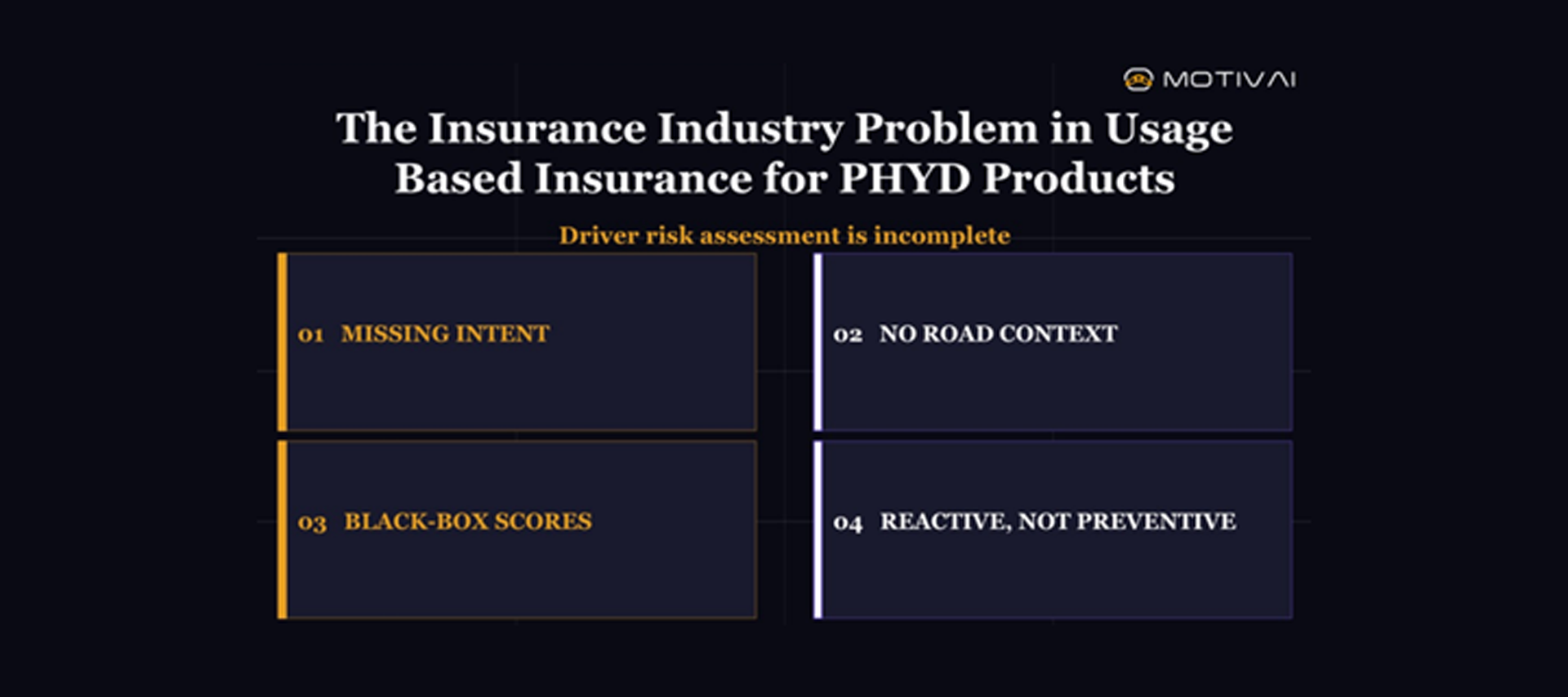
Insurers have been measuring acceleration, cornering, and braking for years. But these metrics miss what actually matters:
The industry has been measuring symptoms instead of understanding drivers.
Context. Intent. Explainability. Prevention. That's where UBI needs to go.
Where do you see the biggest gap in UBI scoring today?
#InsurTech #UsageBasedInsurance #UBI #AIinInsurance #MotivAI