
August 5, 2026
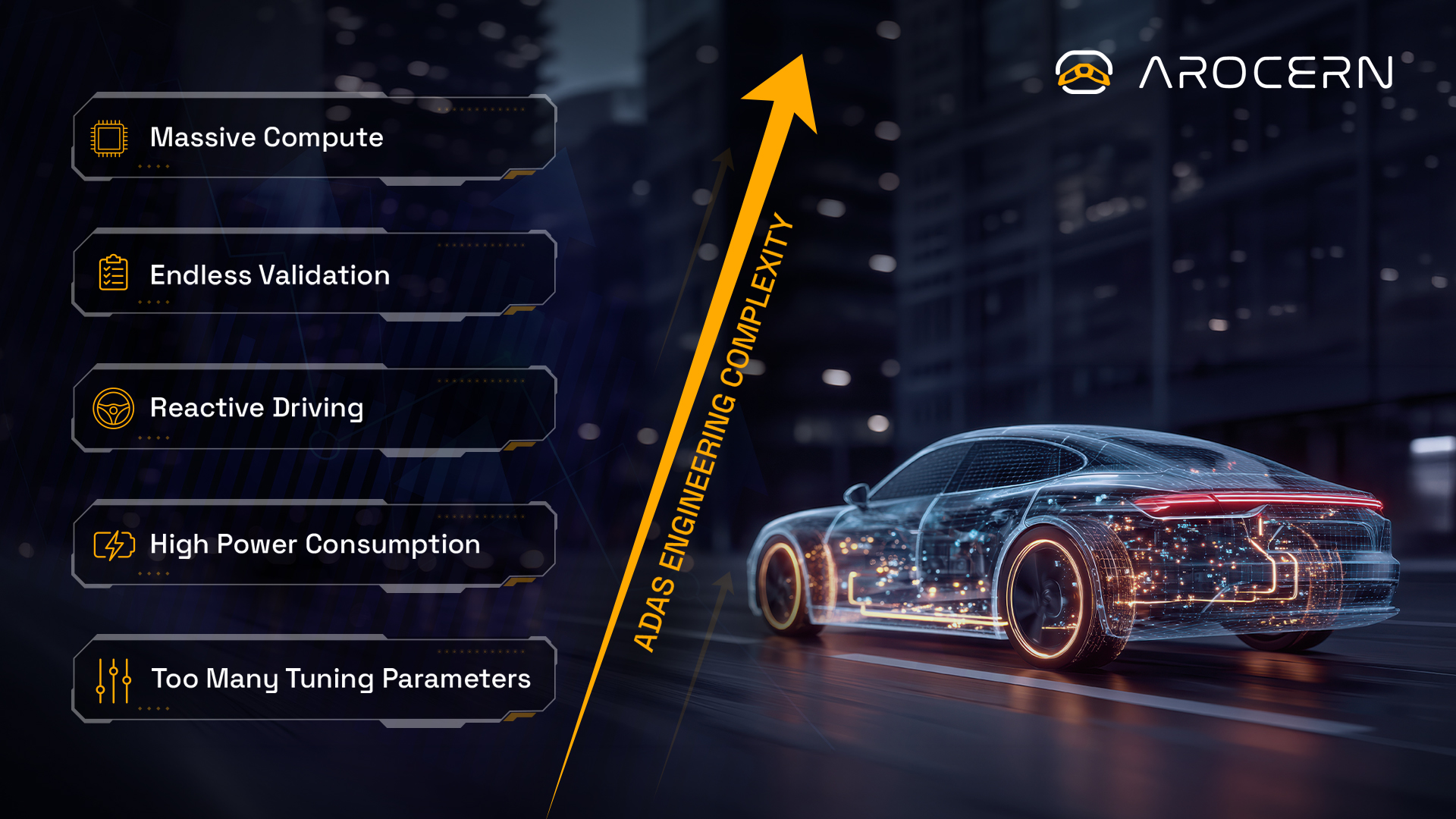
Today, the equation has changed. Adding a new perception capability often means months of additional calibration work, thousands of new validation scenarios, increased hardware requirements and longer development cycles. The technological gain is real but so is the engineering cost. Somewhere along the way, the industry's bottleneck quietly shifted.
Modern ADAS no longer suffer primarily from a perception problem. They suffer from a complexity problem.
Over the past decade, Advanced Driver Assistance Systems have made extraordinary progress.
Vehicles can now detect vulnerable road users, recognisSe traffic signs, estimate free space, monitor driver attention and assist with increasingly sophisticated driving tasks. Few industries have integrated artificial intelligence as successfully as automotive. Yet every new capability carries an invisible consequence.
According to McKinsey, software has become one of the primary differentiators of modern vehicles. At the same time, the amount of software, electronics and validation effort continues to increase, making vehicle development significantly more complex than it was only a few years ago. The industry has become remarkably good at creating intelligent systems. It is now discovering that creating economically scalable intelligent systems is a completely different challenge.
When people discuss ADAS, they usually ask questions such as:
They must decide how to behave under virtually infinite combinations of:
Each new feature increases not only software complexity but also the number of interactions between these variables. This phenomenon deserves a name. I call it Scenario Explosion. Scenario Explosion is not simply an increase in the number of driving situations. It is the exponential increase in the combinations of conditions, behaviours and software interactions that engineers must calibrate and validate before a vehicle can safely reach production. The industry's greatest challenge may therefore no longer be writing more software. It may be controlling the complexity that software creates.
Traditional ADAS architectures generally follow the same philosophy:
This approach has delivered remarkable safety improvements.
However, it also assumes that increasing complexity can always be compensated by additional computing power, additional data and additional testing.
McKinsey has highlighted that software verification and validation are becoming strategic engineering activities rather than secondary development tasks. At the same time, competitive pressure is intensifying as several Chinese manufacturers bring new vehicles to market in roughly half the time required by many traditional OEMs.
The race is no longer only about building better software.
It is about building software that remains economically feasible to deploy.
Complexity affects more than engineering teams. It also affects drivers. Many motorists already have access to sophisticated ADAS functions but rarely use them consistently. One reason is not the lack of technical capability, but the lack of confidence in how these systems behave. Your presentation cites industry findings indicating that a significant proportion of drivers seldom use available ADAS features. Trust depends on more than detection accuracy. Drivers need systems that behave consistently, predictably and understandably. In other words, explainability is no longer simply a regulatory objective. It has become a usability requirement.
A Different Way to Think About ADAS
For years, the industry has tried to teach machines to recognize everything. Perhaps the next challenge is different. Perhaps the objective should be teaching vehicles to make better driving decisions. Imagine two vehicles approaching the same blind intersection.
From the driver's perspective, the difference appears subtle. From an engineering perspective, it is profound. One architecture attempts to validate millions of individual situations. The other validates a much smaller number of coherent behavioural principles. That distinction may ultimately determine which architectures remain economically scalable.
One possible response to Scenario Explosion is what can be described as a Contextual Prudence Architecture.
Instead of relying exclusively on perception, decision-making continuously integrates:
The objective is no longer simply to identify hazards. It is to understand the driving context before deciding how the vehicle should behave. This change has important engineering consequences. It reduces the number of independent behaviours that require calibration.
It improves explainability. It simplifies validation. And it allows manufacturers to preserve their own driving philosophy rather than converging toward identical vehicle behaviour. These are themes emphasized throughout the MOTIV AI approach described in the presentation.
For many years, ADAS progress has been measured through perception accuracy. That metric remains important. But another may become equally critical.
Engineering productivity.
Reducing validation effort by 30% may ultimately create more industrial value than improving perception accuracy by 2%. Not because perception no longer matters. But because engineering scalability has become one of the defining competitive advantages of the Software Defined Vehicle era.
The Next Brand Differentiator.
Automotive history has always been shaped by differentiation.
Tomorrow, differentiation may increasingly depend on something less visible:
Driving behaviour.
As perception technologies become progressively standardized, the way a vehicle behaves may become one of the last remaining expressions of an OEM's identity. Future ADAS architectures will therefore need to achieve two objectives simultaneously:
That balance may define the next generation of intelligent vehicles.
For decades, automotive innovation has been measured by horsepower. Later, by fuel efficiency. More recently, by autonomous capability. The next decade may be measured by something far less visible. Engineering simplicity. Technologies rarely transform industries by becoming more complicated. They transform industries by making complexity disappear.
The real question is therefore no longer:
That shift in perspective may prove to be the most important architectural change in the future of ADAS.
